


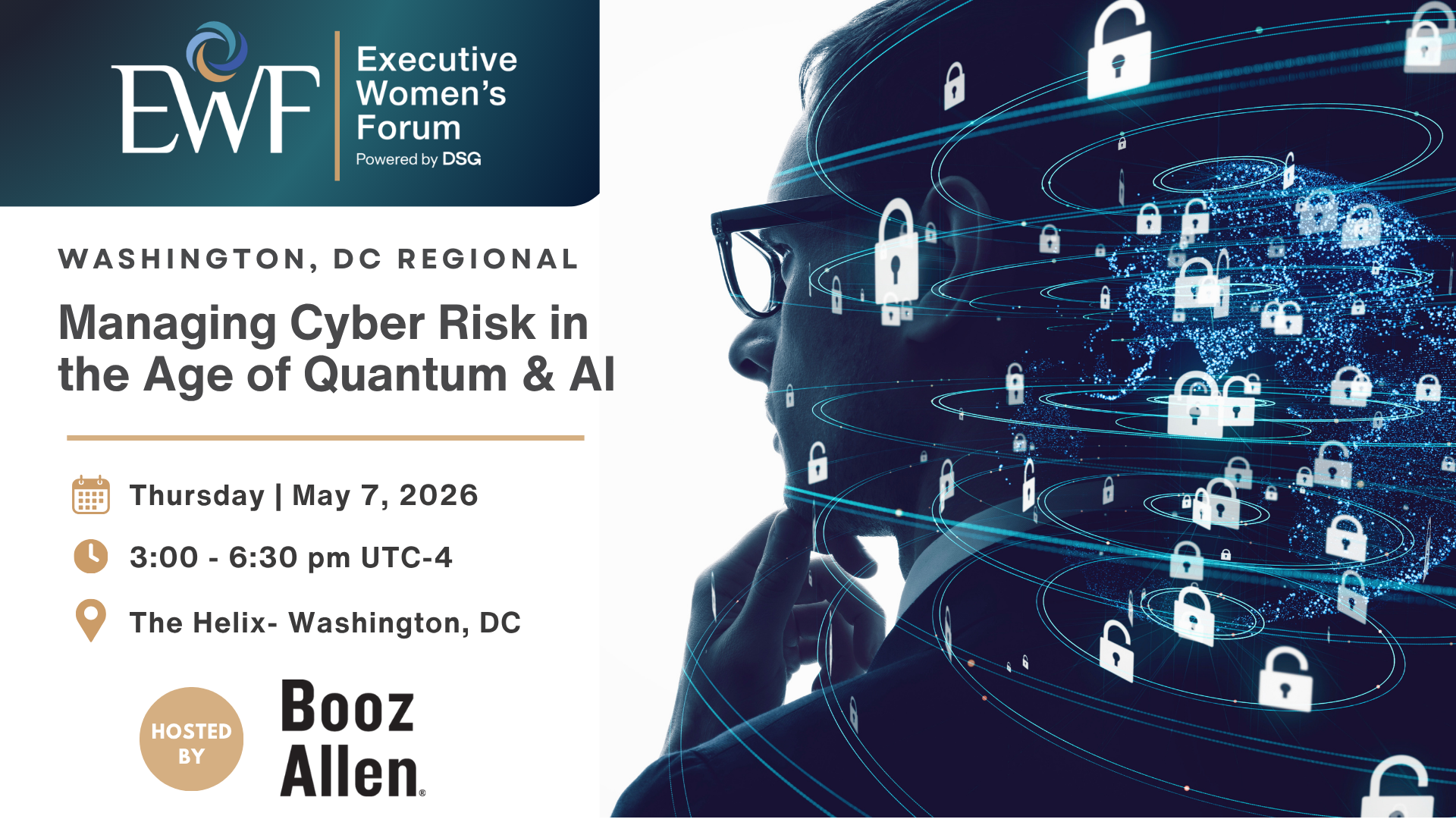
Washington, DC Regional | Managing Cyber Risk in the Age of Quantum & AI Hosted by Booz Allen
When
Where
Contact
May 7th, 2026
3:00 pm - 6:30 pm
UTC-4
The Helix, Booz Allen’s Center for Innovation
901 15th St NW
Washington, DC 20005
United States
This event is no longer being held. We encourage you to check out our events calendar for additional opportunities to connect.
. . .
Managing Cyber Risk in the Age of Quantum & AI
Hosted by Booz Allen
Join us in Washington, DC for an engaging regional event hosted by Booz Allen, where industry leaders will explore how organizations can navigate the evolving intersection of quantum computing, artificial intelligence, and operational technology. As emerging technologies reshape the threat landscape, this session will provide critical insights into building resilient, future-ready cybersecurity strategies—spanning cryptographic risk, AI governance, and real-world applications in operational environments.
This event will be certified for 2.25 CPE/ISC2 credits and 2.5 ISACA credits.
. . .
The convergence of quantum computing and artificial intelligence is fundamentally reshaping cryptographic risk management, creating an urgent need for organizations to act now even as threats remain years away. Quantum computers will eventually break current encryption standards like RSA and ECC that protect everything from financial transactions to classified communications. Meanwhile, AI is already accelerating cryptanalysis—machine learning models can identify patterns in encrypted data and optimize attack strategies faster than traditional methods. Forward-thinking organizations are adopting crypto-agility, including inventorying all cryptographic assets, identifying quantum-vulnerable systems, and beginning migration to post-quantum cryptography (PQC) standards. Crypto-agility isn’t just about algorithms—it requires governance frameworks that can adapt as both quantum capabilities and AI-driven threats evolve in parallel.
This is where AI governance becomes critical, particularly as organizations deploy AI not just as a threat vector to defend against, but as a defensive capability embedded throughout their security operations. Effective AI governance establishes guardrails for how AI models access sensitive data, make autonomous decisions, and interact with critical systems. It addresses questions like: Which AI systems can operate without human oversight? What data can train models? How do we audit AI-driven security decisions? To address this, companies should build AI governance frameworks that balance innovation with control—enabling security teams to leverage AI for threat detection, incident response, and vulnerability management while maintaining compliance, explainability, and accountability. These frameworks become even more essential when AI moves beyond IT environments into operational technology.
Operational technology environments are the industrial control systems, SCADA networks, and IoT devices running power grids, manufacturing plants, and critical infrastructure. They present unique AI challenges and opportunities. On one hand, AI enables powerful new OT use cases: predictive maintenance models that prevent equipment failures, computer vision systems that detect safety hazards, and optimization algorithms that improve production efficiency. On the other hand, OT environments were never designed with modern cybersecurity in mind, and introducing AI without proper governance creates new attack surfaces. Organizations should take a dual-approach to securely enable AI use cases in OT by designing architectures that isolate AI workloads, implement zero-trust principles, and maintain operational safety, while simultaneously deploying AI to secure OT environments through anomaly detection that identifies unusual network behavior, automated threat hunting across legacy protocols, and AI-driven asset discovery that maps previously invisible OT infrastructure.
This integration of cryptographic resilience, AI governance, and OT security is a unified strategy for the next decade of cyber threats. When a quantum computer can break encryption protecting SCADA communications, when AI-generated attacks can exploit OT vulnerabilities faster than humans can patch them, and when critical infrastructure depends on AI systems that must remain both effective and trustworthy, organizations need to understand how these domains intersect. From achieving crypto-agility in their most sensitive systems, to building governance frameworks that enable responsible AI adoption, to deploying AI-powered defenses in the OT environments where attacks have real-world consequences beyond data loss, organizations cyber defense plans need to span the full spectrum—where failures to do so can mean power outages, production shutdowns, or physical safety risks.
Event Agenda
3:00 – 3:15 PM
Registration and Refreshments
3:15 – 3:25 PM
Welcome and Opening Remarks
Emily Helmke – Vice President | Booz Allen Global Commercial
3:25 – 3:45 PM
Keynote
Joyce Brocaglia – CEO and Founder | Executive Women’s Forum
3:45 – 4:15 PM
Managing Cryptographic Risk in the Age of Quantum & AI
Jordan Kenyon – Senior Quantum Scientist | Booz Allen
4:15 – 4:45 PM
Cyber AI Governance
Rita Ismaylov – Lead Data Scientist | Booz Allen
4:45 – 5:15 PM
Cyber AI in Operational Technology
Pia Capra – Director Global Commercial OT | Booz Allen
5:15 – 5:30 PM
Closing Remarks
Nicole Monteforte – Senior Vice President – Global Commercial | Booz Allen
5:30 – 6:30 PM
Networking and Happy Hour
Speakers
-
 Joyce BrocagliaCEO and Founder | Executive Women’s Forum
 -
 Pia CapraDirector Global Commercial OT | Booz Allen
 -
 Emily HelmkeVice President | Booz Allen Global Commercial
 -
 Rita IsmaylovLead Data Scientist | Booz Allen
 -
 Jordon KenyonSenior Quantum Scientist | Booz Allen
 -
 Nicole MonteforteSenior Vice President – Global Commercial | Booz Allen